Why It Takes So Long to Fix the Dental Team Shortage
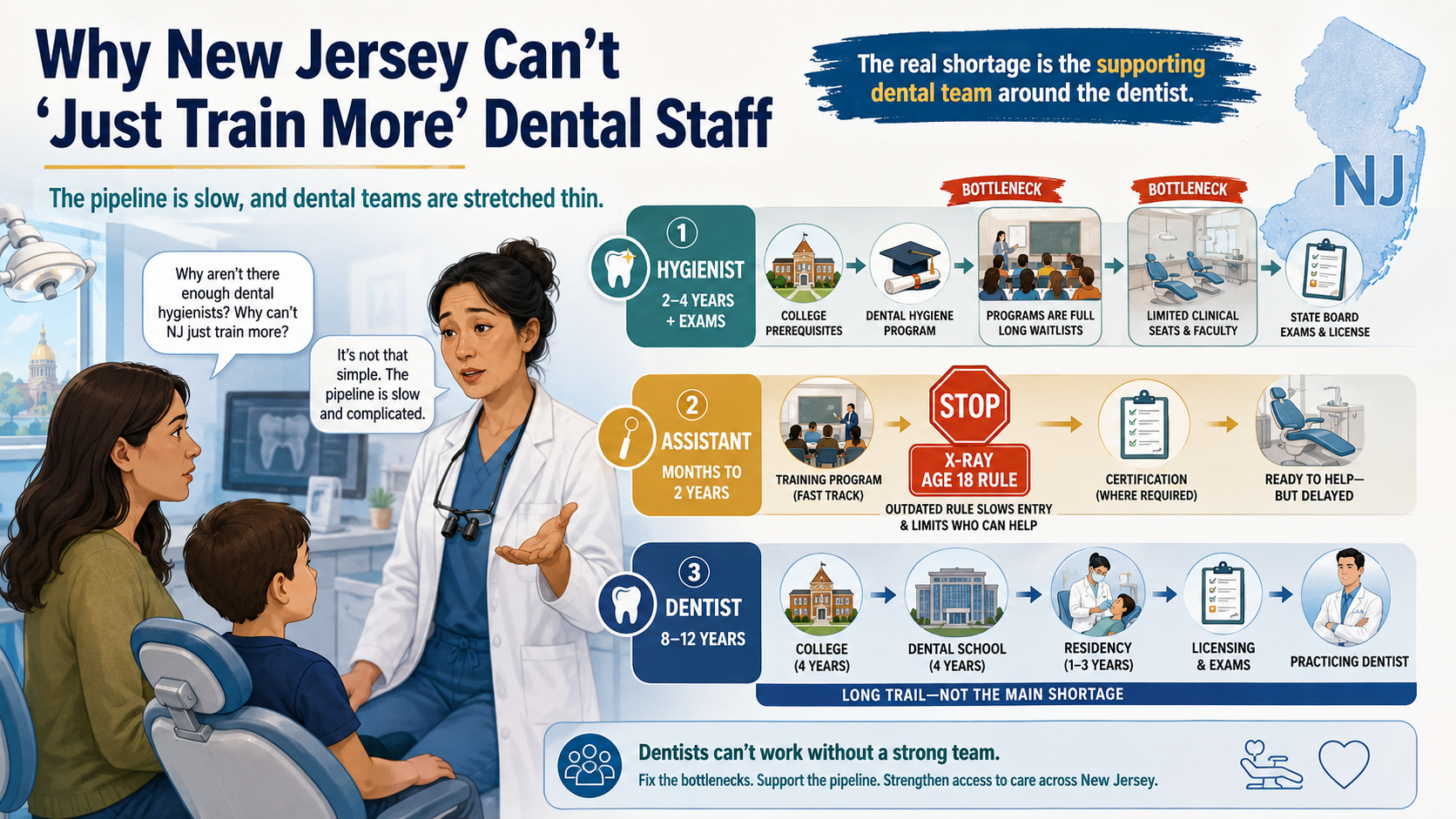
A parent in Middlesex County asked her dentist a reasonable question: “If there aren’t enough hygienists, why doesn’t someone just train more?” Her dentist smiled the tired smile of someone who has heard the question a hundred times. “That’s what I asked too,” she said. “The answer is more complicated than it should be.”
Growing the dental care team in New Jersey is not like hiring for a warehouse or a restaurant. Every person on the team – the hygienist who cleans your teeth, the assistant who prepares the room, the dentist who leads the visit – needs specific training, specific credentials, and in some cases, permission from state agencies that do not always move quickly. Here is what the path actually looks like, and why “just train more people” is not as simple as it sounds.
How long does it take to become a dental hygienist?
Two to four years of college-level education, plus licensing exams. That is the fastest it can go. In New Jersey, the programs that train hygienists are already full. They cannot add more students without hiring more faculty and finding more dental offices willing to host hands-on training rotations – and both of those are in short supply too.
What this means for you: even if a student starts a hygiene program tomorrow, she will not be ready to work in your dentist’s office until 2028 at the earliest.
How long does it take to become a dental assistant?
It can be as short as a few months of on-the-job training or up to two years in a formal program. This should be one of the fastest ways to grow the dental care team – and in many states, it is. But in New Jersey, there is an outdated rule that says you have to be 18 years old to operate dental X-ray equipment, even if a dentist is standing right next to you supervising every step.
That rule blocks high school career training programs from preparing students for dental assisting jobs. In states without that rule, students graduate high school ready to work on a dental team. In New Jersey, they have to wait two more years and find another path. That is two years of team members the state is not producing.
How long does it take to become a dentist?
Eight to twelve years after high school – four years of college, four years of dental school, and sometimes additional years of residency. That is the longest path on the team. And here is the part most people do not realize: New Jersey does not have a major dentist shortage. Dentists are graduating. The shortage is in the rest of the team around them. Training more dentists is the slowest possible answer to the wrong question.
Why keeping the current team matters even more than growing a new one
While training programs take years, the team members who already work in dental offices across New Jersey can be supported right now. Competitive wages so they stay instead of leaving for a neighboring state. Manageable workloads so the paperwork does not push them out. Real career paths within the dental team so the job feels like a profession, not a dead end.
None of this fixes the problem overnight. But all of it works faster than waiting for the next graduating class.
What you can do
If your dentist’s office tells you they are short-staffed and appointments are running further out than usual, now you know why. The team around the dentist is stretched thin, and the pipeline to replace them is slow. Your patience with the front desk matters more than you realize. And if someone you know is considering a career in health care, dental hygiene and dental assisting are fields with immediate demand, strong wages, and the chance to make a real difference in people’s lives every day.