Why can’t practices just hire more staff?
Your dentist wants to hire. You should know that.
When the front desk tells you the wait is longer than it used to be, or that Saturday hours are gone, or that the hygienist you liked has moved on and there is no replacement yet – it is easy to assume the office is not trying hard enough. The reality is almost always the opposite.
A dental practice in Bergen County posted an opening for a hygienist and kept it open for nine months. The owner did everything a small business owner can do. He posted on job boards. He contacted every hygiene training program in the region. He asked his staff to reach out to colleagues. He adjusted the compensation. Twice. In nine months, two people applied. One accepted a different offer the day after interviewing. The other accepted the position and then found a job with a shorter commute before her start date.
This is not a story about one unlucky practice. It is a pattern playing out in dental offices across New Jersey right now.
Why the dental team is so hard to build
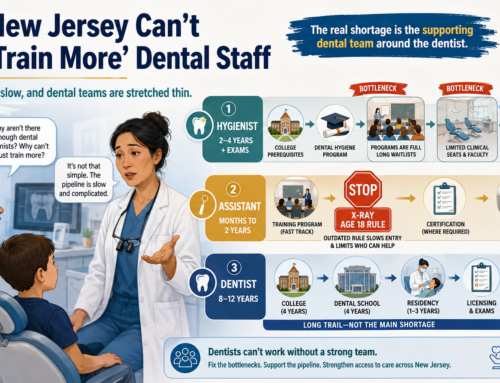
There are not enough dental hygienists and dental assistants in New Jersey to fill the positions that are open. The training programs that produce new graduates are running at capacity and cannot grow fast enough. And the professionals who are already in the field have options – which means they can choose where to work based on the same things any worker considers: commute, compensation, workload, the quality of the work environment, and whether the job feels like a career or a dead end.
None of that is unreasonable. These are skilled healthcare professionals making rational choices about their working lives. The problem is not that they are being difficult. The problem is that there are far more open positions than there are people to fill them, and every practice in the state is competing for the same small pool.
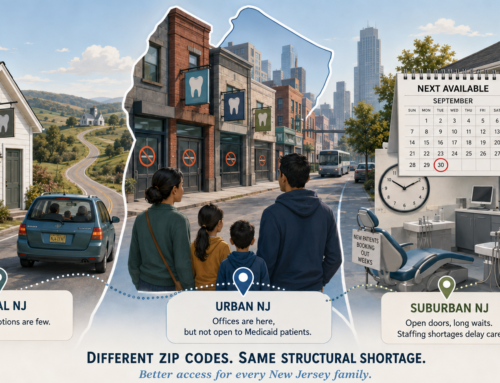
That competition is not equal. An office in a suburban county close to major highways and surrounded by restaurants and daycare can attract a hygienist more easily than an office in a rural county where the commute is 40 minutes and the nearest lunch option is a gas station. A larger practice that can offer benefits, predictable hours, and a team environment has an advantage over a solo practice where one person does everything. And a practice whose insurance reimbursements cover the real cost of care can offer stronger compensation than a practice squeezed between rising costs and stagnant payment rates.
The offices struggling most are often the ones serving the communities that need them most.
What your dentist wishes you knew
When your dentist’s office is short-staffed, the people still there are doing more with less. The front desk is fielding more calls. The remaining hygienist – the one who is screening you for oral cancer, checking for gum disease, taking your X-rays, and managing your preventive care in addition to the cleaning you came for – is seeing a schedule that was built for two people. The dentist is absorbing work that the team used to share, which pushes everything else back.
They are not being slow. They are not being careless. They are holding a small business together while waiting for a hire that may take months to find.
What this means for you
Your patience with a short-staffed dental office is not just kindness. It is an investment. A good dental practice that knows your history, understands your needs, and has earned your trust is worth the inconvenience of a longer wait while they rebuild the team. The alternative – bouncing to a new office every time the schedule gets tight – means starting over with someone who does not know you.
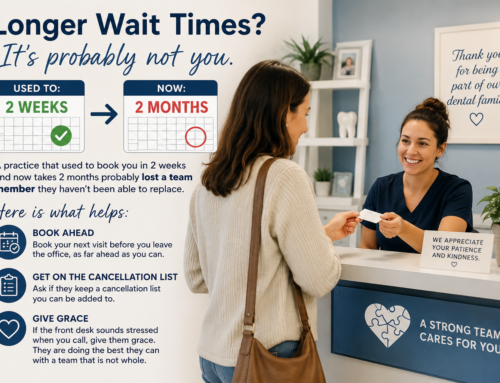
Here is what helps while the office is short-staffed. Book your next visit before you leave, as far ahead as you can. Ask about the cancellation list. If you have flexibility on timing, offer it – midweek mornings are often easier to fill than Friday afternoons. And if the front desk sounds overwhelmed when you call, remember that the person answering the phone is probably covering for the person they have not been able to replace.
If your wait time has grown past what you can manage and you need care sooner, community health centers and dental school clinics can sometimes see patients faster because their staffing model is different. Visit our Find Care page for options near you.