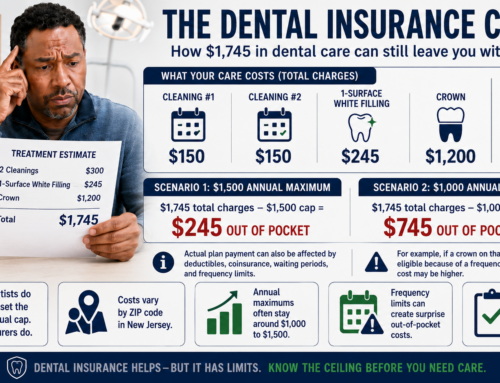
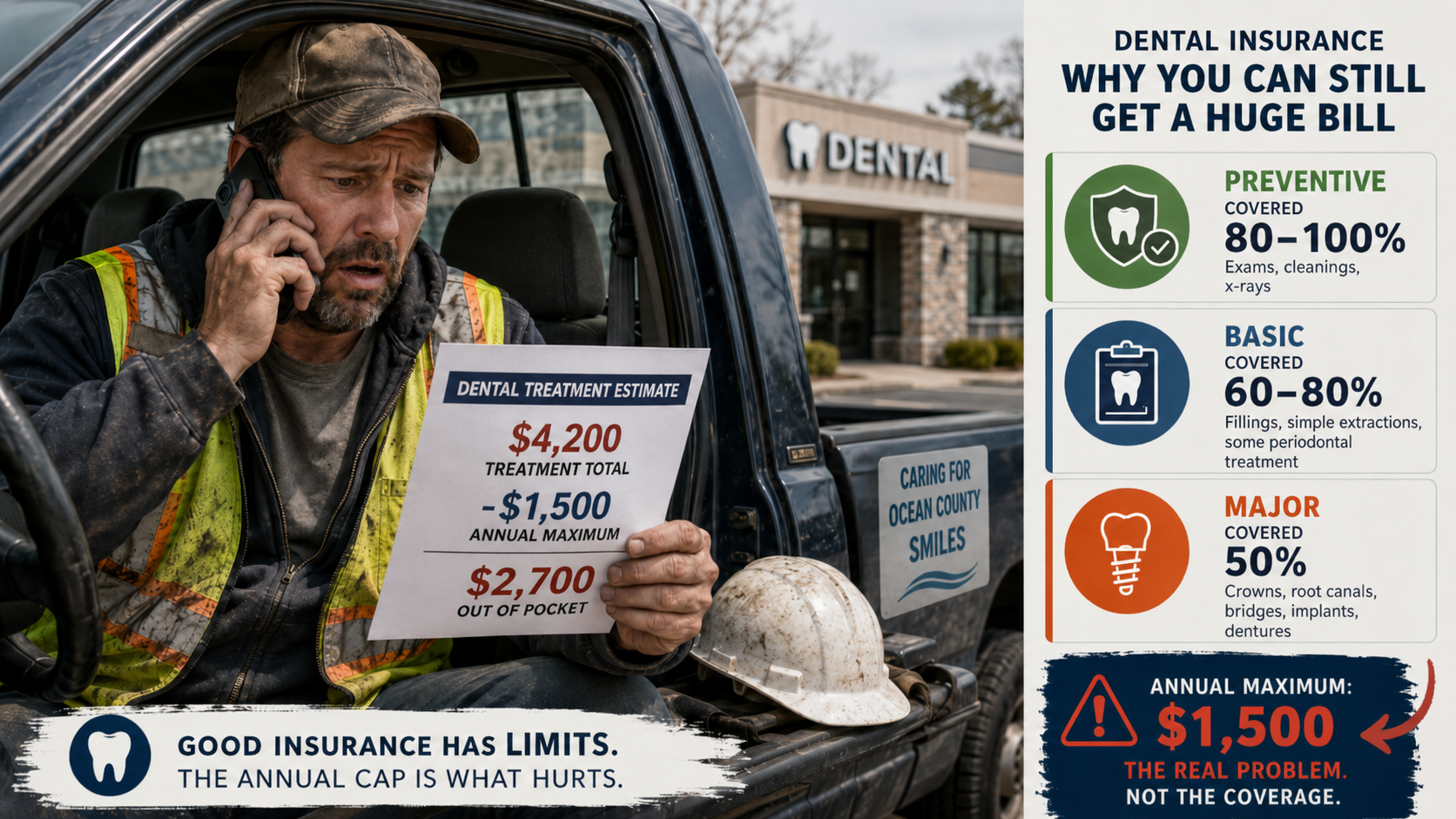
A construction supervisor in Ocean County went to his dentist for what he thought was a routine visit. The dentist found a cracked molar that needed a crown and a second tooth that needed a root canal and a buildup. Total estimated cost: about $4,200.
He was not worried. He had dental insurance through his union. He had been paying into it for twelve years.
His plan covered the crown at 50 percent and the root canal at 50 percent – but only up to his $1,500 annual maximum. After the plan paid its share, he owed $2,700 out of pocket. More than half the bill. For a man who had been paying premiums for over a decade.
He sat in his truck in the parking lot and called his wife. “I thought we had insurance,” he said. They did. It just did not work the way either of them thought it did.
The three tiers most people do not know about
Dental plans divide every procedure into one of three categories, and each category has a different coverage level.
Preventive care – your cleanings, exams, and basic X-rays – is usually covered at 80 to 100 percent. This is the tier that makes dental insurance feel like it works. You go twice a year, the plan pays most of it, and you walk out thinking the system is functioning.
Basic care – fillings, simple extractions, some periodontal treatments – drops to 60 to 80 percent. You start paying more, but the amounts are usually manageable.
Major care – crowns, root canals, dentures, bridges, implants – drops to 50 percent. This is where the math falls apart. A $1,400 crown at 50 percent coverage means $700 out of your pocket. And that $700 your plan did pay counts against your annual maximum, which means you may have just used up most of your year’s benefit on one tooth.
The tiers create a paradox. The care that costs the least is covered the most. The care that costs the most is covered the least. And the annual ceiling means that even the reduced coverage you do get has a hard limit.
This is not health insurance
If you had a medical emergency that cost $4,200, your health insurance would cover most of it after your deductible. You might owe a few hundred dollars. The plan would absorb the financial shock – that is literally what health insurance is designed to do.
Dental insurance was never designed to do that. It is a capped benefit product – it helps with maintenance and covers a portion of treatment up to a fixed dollar limit. After that limit, you are on your own. It is closer to a discount program with a ceiling than to the insurance you carry for your car or your body.
This is not a criticism of any specific plan or carrier. It is a description of how the product category works. And most people do not learn this until they are sitting in a parking lot doing math they did not expect to do.
What you can do about it
Know your tiers before you need them. Ask your dentist’s office or your HR department which tier each procedure falls into – preventive, basic, or major. Knowing the tier tells you what percentage your plan will cover before you commit to treatment.
Ask for a pre-authorization on any procedure expected to cost more than $300. Your dentist’s office submits the treatment plan to your insurance carrier, and the carrier sends back an estimate of what they will pay. It costs nothing to request and it tells you the real out-of-pocket number before you sit in the chair.
And if a major procedure is recommended, ask your dentist whether any of the work can be sequenced over time to spread across your benefit year – or across two benefit years if you are near the end of one. You are allowed to plan. The system does not make it easy, but your dentist’s office can help.