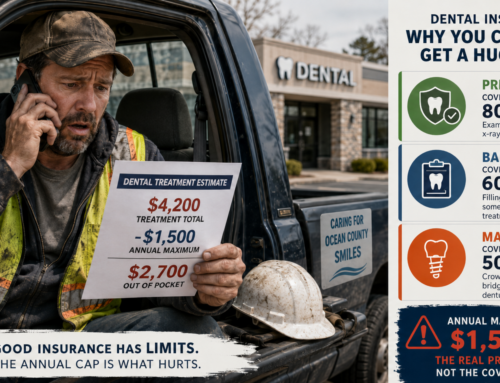
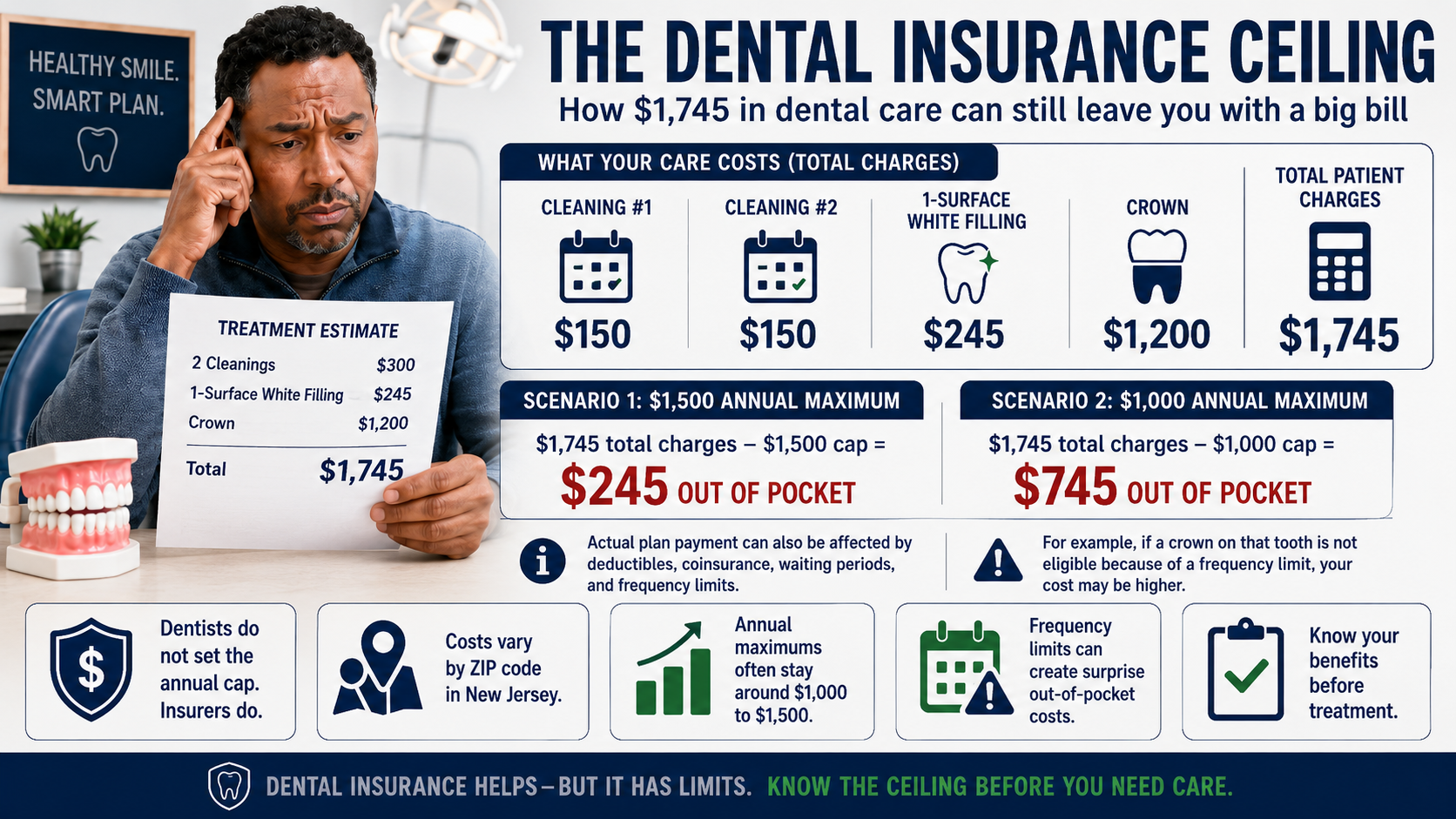
A teacher in Passaic County needed a crown last October. She had dental insurance through her district. She had been to the dentist twice already that year for cleanings and a filling. When the office submitted the crown to her insurance, the answer came back: her plan would cover part of it, but she had already used most of her annual benefit. The remaining balance for the crown was $1,100 out of pocket.
She called her insurance company to ask if there had been a mistake. There had not. Her plan’s annual maximum – the most it would pay in a single year – was $1,500. Between the cleanings, the filling, and the portion of the crown the plan did cover, she had hit the ceiling. Everything from that point forward, for the rest of the plan year, was on her.
She told her dentist she needed to wait. The crown is still waiting.
How the ceiling works
Most dental plans cap what they will pay each year somewhere between $1,000 and $1,500. If your care in a given year costs less than that, the plan works the way you expect. If your care costs more – and a single crown, root canal, or unexpected extraction can get you there in one visit – you pay everything above the cap yourself.
Here is the part that shocks most people when they learn it: that $1,000 to $1,500 cap has barely changed since the 1970s. Your grandparents may have had a dental plan with a $1,000 annual maximum. You probably do too. The premium you pay has gone up. The cost of every dental procedure has gone up. The cap has not.
To put it another way: if the cap had kept pace with inflation, a $1,000 maximum from 1970 would be roughly $8,000 today. Instead, it is still $1,000. The gap between what dental care costs and what your plan will pay has been growing wider every year for over fifty years.
Why this is not like your health insurance
When you break your arm, your health insurance covers most of the bill. There might be a copay or a deductible, but the plan is designed to protect you when something expensive happens. That is the whole point of insurance – you pay premiums so that a catastrophic event does not bankrupt you.
Dental plans are designed differently. They were never built to protect you from catastrophic cost. They were built around a yearly ceiling and a tiered system that shifts more cost to you as treatment gets more serious. Preventive care like cleanings is usually covered at 80 to 100 percent. Basic work like fillings drops to 60 to 80 percent. Major work like crowns and root canals often drops to 50 percent. And that 50 percent still counts against your annual maximum.
The result is a product that helps with routine care and disappears when you need it most. That is not a bug in the system. It is how the system was designed.
What you can do about it
You cannot change your plan’s annual maximum. But you can plan around it.
Before any procedure beyond a cleaning, ask your dentist’s office two questions: “How much of my annual maximum have I used this year?” and “What will my estimated out-of-pocket cost be?” Get the answer before you say yes to treatment, not after.
If you need major work and your benefit is running low, ask whether the treatment can be phased across two plan years. A crown started in November and completed in January uses benefits from two separate years instead of one. Not every procedure can be split, but many can – and your dentist’s office can help you plan the timing.
If you have already hit your ceiling and still need care, ask about payment plans. Many offices offer them. And community health centers and dental school clinics provide care at reduced fees regardless of your insurance status. Visit our Find Care page for options near you.
The ceiling is real. But knowing it exists before you hit it is the difference between a surprise and a plan.
A teacher in Passaic County needed a crown last October. She had dental insurance through her district. She had been to the dentist twice already that year for cleanings and a filling. When the office submitted the crown to her insurance, the answer came back: her plan would cover part of it, but she had already used most of her annual benefit. The remaining balance for the crown was $1,100 out of pocket.
She called her insurance company to ask if there had been a mistake. There had not. Her plan’s annual maximum – the most it would pay in a single year – was $1,500. Between the cleanings, the filling, and the portion of the crown the plan did cover, she had hit the ceiling. Everything from that point forward, for the rest of the plan year, was on her.
She told her dentist she needed to wait. The crown is still waiting.
How the ceiling works
Most dental plans cap what they will pay each year somewhere between $1,000 and $1,500. If your care in a given year costs less than that, the plan works the way you expect. If your care costs more – and a single crown, root canal, or unexpected extraction can get you there in one visit – you pay everything above the cap yourself.
Here is the part that shocks most people when they learn it: that $1,000 to $1,500 cap has barely changed since the 1970s. Your grandparents may have had a dental plan with a $1,000 annual maximum. You probably do too. The premium you pay has gone up. The cost of every dental procedure has gone up. The cap has not.
To put it another way: if the cap had kept pace with inflation, a $1,000 maximum from 1970 would be roughly $8,000 today. Instead, it is still $1,000. The gap between what dental care costs and what your plan will pay has been growing wider every year for over fifty years.
Why this is not like your health insurance
When you break your arm, your health insurance covers most of the bill. There might be a copay or a deductible, but the plan is designed to protect you when something expensive happens. That is the whole point of insurance – you pay premiums so that a catastrophic event does not bankrupt you.
Dental plans are designed differently. They were never built to protect you from catastrophic cost. They were built around a yearly ceiling and a tiered system that shifts more cost to you as treatment gets more serious. Preventive care like cleanings is usually covered at 80 to 100 percent. Basic work like fillings drops to 60 to 80 percent. Major work like crowns and root canals often drops to 50 percent. And that 50 percent still counts against your annual maximum.
The result is a product that helps with routine care and disappears when you need it most. That is not a bug in the system. It is how the system was designed.
What you can do about it
You cannot change your plan’s annual maximum. But you can plan around it.
Before any procedure beyond a cleaning, ask your dentist’s office two questions: “How much of my annual maximum have I used this year?” and “What will my estimated out-of-pocket cost be?” Get the answer before you say yes to treatment, not after.
If you need major work and your benefit is running low, ask whether the treatment can be phased across two plan years. A crown started in November and completed in January uses benefits from two separate years instead of one. Not every procedure can be split, but many can – and your dentist’s office can help you plan the timing.
If you have already hit your ceiling and still need care, ask about payment plans. Many offices offer them. And community health centers and dental school clinics provide care at reduced fees regardless of your insurance status. Visit our Find Care page for options near you.
The ceiling is real. But knowing it exists before you hit it is the difference between a surprise and a plan.